
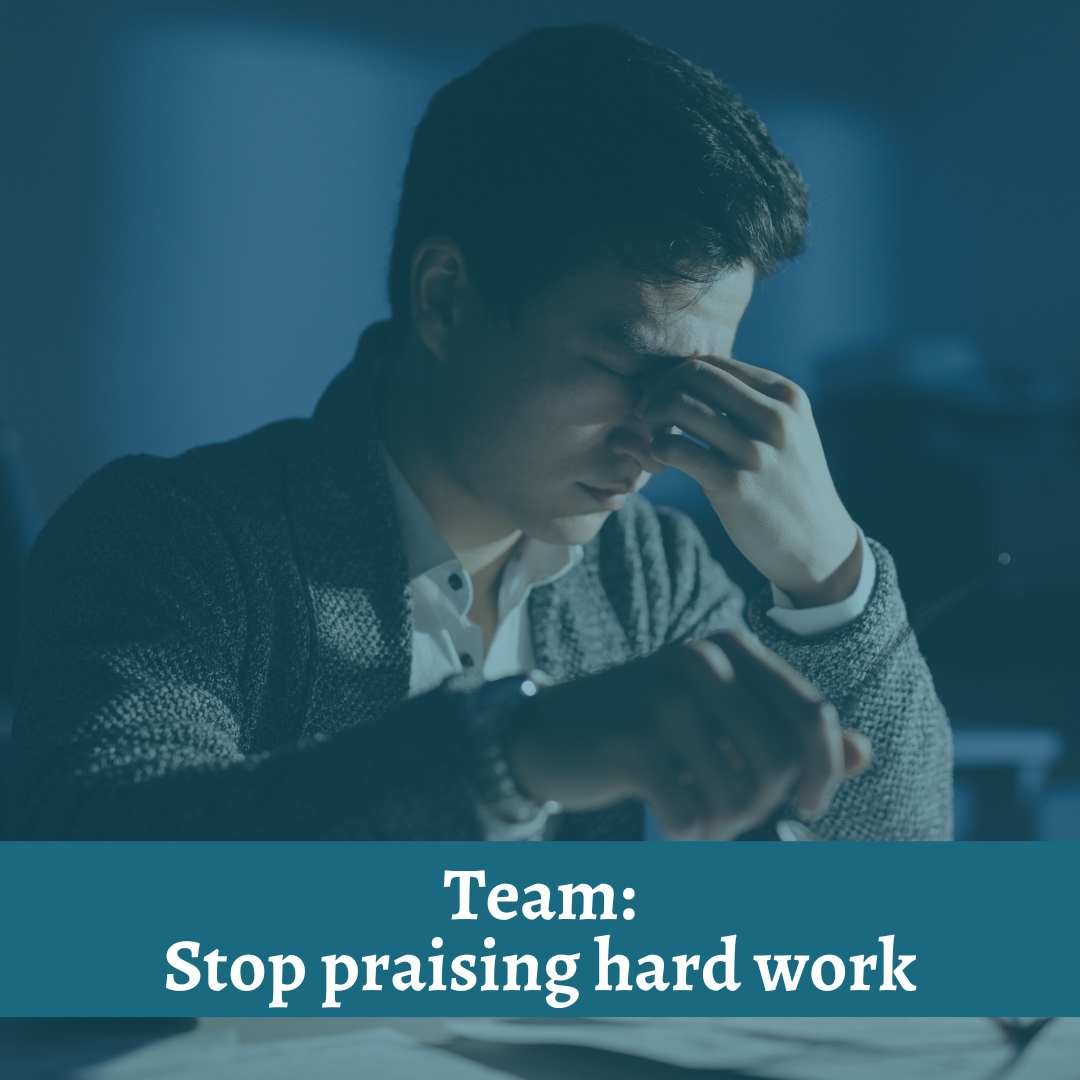
Why Praising Hard Work Is Wrong—and What to Do Instead
When employees put in long hours, sacrifice weekends, and go above and beyond, it’s easy to see it as a sign of commitment. And in many ways, it is. People want to do a good job. They care. They’re trying. But work shouldn’t feel like “hard work”. If it does, we (as leaders) have let them down.
We’ve created an environment that demands it. But here’s the thing—fixing that doesn’t have to mean throwing money at expensive systems or hiring more people. What if there were a way to unlock performance without adding more resources? (spoiler: there is…)
The Real Root Cause
So why are people working hard instead of working well? They spend too little time in their strengths.
When tasks don’t align with natural abilities, everything takes more effort. Decision-making slows, creative problem-solving suffers, and energy gets depleted faster. Instead of feeling accomplished, people feel drained. This leads to:
🚩More mistakes and inefficiency – Errors create extra work (re-work), compounding the problem and making the next task even harder.
🚩Wasted effort – People push through tasks that someone else could do faster and better, just because that’s how work is assigned.
🚩Unsustainable workloads – Over time, working outside strengths depletes energy, leading to frustration and burnout.
Sure, under-resourcing and/or outdated systems make things harder than they need to be. But throwing more people or different tools at the problem is an expensive way to improve it, and one that perpetuates an underlying cause. Instead of adding extra costly resource, start by realigning work within the team to lean on individuals’ strengths and see what falls out. The impact is quite remarkable.
The low-cost, high impact alternative
When people work in their strengths, everything changes:
✅ Tasks take less effort – Work feels natural, freeing up energy for deeper thinking and creativity.
✅ Solutions come faster – People enjoy solving problems in their areas of expertise, making decision- making smoother.
✅ Satisfaction increases – High-quality work leads to recognition and reward, reinforcing a positive cycle.
Happier employees are more productive. When people enjoy their work, they deliver higher quality results, move faster, and feel more valued. And when their work is valued, they’re recognised for the right reasons—producing something excellent, not just slogging through it.
Why Isn’t This Already the Norm?
Two key reasons:
1. We’ve been conditioned to reward effort over results.
From school, we learn that effort matters as much as outcomes. While well-intentioned, this leads to adults undervaluing what they find easy to do. Instead, they pride themselves on working hard rather than delivering effortlessly. But their hard work rarely delivers anything better than good. So we praise their efforts, but have little reward to back it up (because it’s not exceptional enough). Over time, this turns negative.
2. Work isn’t structured around strengths.
Instead of shaping roles to maximise individual talents, tasks are assigned based on a pre-determined job roles. This ‘fixes’ tasks to individuals and locks in challenge areas, rather than work being redistributed to those naturally best suited to it.
We also fail to distinguish between true strengths (where someone delivers effortless value) and learned skills, knowledge, or experience (where they simply know how to do something). We recruit for the latter. So they know how to do it. But we don’t know which bits they find easy or hard. And their learned behaviour is likely to be “hard work is valuable”, so they aren’t necessarily expecting anything to be different.
A Real-World Example
Back in 2014, I joined a project team that had been running for six months. It had some quick wins early on, but was now completely stuck. The problem wasn’t lack of skill—everyone in the team was experienced. The real issue was how the work was distributed. Everything was a group decision, and the best person for the job could easily be overruled by a vote. It was a mess.
On my first day with this large multinational, I had a laptop and desk but no chair. Yet just three weeks later, I was sat with the key stakeholders, talking through the one-page roadmap I had designed to get everyone unstuck. The approach was now clear, but the team still wasn’t.
So I restructured how we worked. I identified who was best suited to each area and gave them authority over it – removing decisions by committee and ensuring the right people made the calls. The work was redistributed based on strengths (and away from weaknesses), rather than job titles.
The result? The 12 month project, which had stalled for months, was delivered on time and on budget exactly as I’d planned on my one-page roadmap. It worked, because the team was on fire – passionate, engaged, fast to decide, and highly motivated. We had a lot of fun together too.
This isn’t a one off. I’ve applied this approach time and time again, across project teams, direct reports, business restructures, and offshoring initiatives. It always comes down to the same things: understand strengths, ensure everyone knows who to go to for what, and distribute the responsibilities accordingly. Then the results speak for themselves.
What Can You Do About productivity?
Start by looking at how work is distributed in your team:
- Identify each team member’s strengths – what do they do exceptionally well, with less effort than others?
- Map out their current responsibilities – how much of their workload sits in their strength zone vs. areas that drain them?
- Look for swaps – can tasks be shifted to better align with strengths? Even small adjustments can create massive efficiency gains.
I’ve developed a system to help with this—The Ability Scale™—which visually maps out individual strengths, weaknesses, and the tasks that fall in between.
Running this as a structured session with an external facilitator (like me) brings clear and actionable insights. It provides the space to safely reflect and adapt: to quickly identify strengths, uncover hidden inefficiencies, and make real-time adjustments that drive performance. It’s simple, powerful, and delivers immediate results.
What all this means…
Rewarding hard work encourages the wrong behaviour: if people are working outside their strengths, they’ll keep struggling, burning out, and delivering less than their potential—no matter how hard they push. They feel their efforts go unrewarded, because sadly their outputs aren’t worthy of significant praise. In the end, everyone loses.
But when work is aligned with strengths, everything gets easier. Efficiency goes up, morale improves, and performance skyrockets. And best of all? You don’t need more people or more money to make it happen.
If you think this could help your team, let’s explore it together. Book in a call below, and let’s start working smarter—not harder ⬇️
